Tag Archives: motherhood

Signs Your Pelvic Floor Might Need Some Attention With The Lifted Lotus

You know your body better than anyone. You notice when something feels off, even if you can’t quite name it: a twinge in your back, a heaviness in your pelvis, a pattern that’s crept in slowly enough that you’ve started to explain it away.

Here’s the thing about the pelvic floor: it’s easy to ignore until it isn’t. So many of its symptoms get quietly normalized. “That’s just what happens after kids.” “That’s just getting older.” “That’s just stress.” A lot of people live with pelvic floor dysfunction for years before anyone tells them there’s another option.

There’s no magic device or quick fix here, and I’m not going to pretend there is. But there is a path for healing, and it starts with recognizing what your body has been trying to tell you. As an occupational therapy-led clinic, The Lifted Lotus provides whole-person pelvic floor care every single day. Let’s talk about five of the most common signs that your pelvic floor could use some attention, and why each one deserves more than a shrug.

1. Back Pain

Low back pain sends people to physical therapists, chiropractors, and orthopedists all the time, and rightfully so. But the pelvic floor is part of your deep core system, working in coordination with your diaphragm, your abdominal wall, and your deep spinal stabilizers. When one part of that system isn’t pulling its weight, the others compensate, often the low back.

If you’ve been treating back pain for a while without lasting relief, it’s worth asking whether anyone has actually looked at the whole system. Back pain isn’t only about the spine in isolation. It’s about how your breath, your core, and your pelvic floor are working together, or not, to support you through your day. This is especially common postpartum, after abdominal or pelvic surgery, or after long stretches of high stress where breathing patterns shift and core coordination quietly falls apart.

2. Leaking

Leaking urine when you laugh, sneeze, cough, jump, or run is so common that it’s become a punchline. It’s the kind of thing people joke about at baby showers or brush off as a “normal” symptom of having a baby or simply aging. I understand why the humor exists. Naming something absurd can feel like the only way to survive it.

But leaking isn’t something you have to accept as your new normal, and it’s not something you “just have to deal with.” Stress incontinence, urge incontinence, and mixed presentations are all real, diagnosable, and treatable conditions, with a clear evidence base behind pelvic floor rehabilitation as first-line care. Whether it’s happening during exercise, during everyday moments, or catching you off guard when you least expect it, it’s worth real attention, not just a pad and a shrug.

3. Pain With Intimacy

Pain during sex is common. It is not normal.

When intimacy hurts, whether it’s a sharp pain, a burning sensation, or a feeling of tightness or resistance, that’s your body sending you important information. Pay attention to it. This isn’t something you have to just get used to. The pelvic floor muscles can become overactive or hypertonic for all kinds of reasons: childbirth, surgery, chronic stress, past trauma, or years of unconsciously guarding and bracing without ever learning how to release.

What makes this one particularly hard is the silence around it. So many people carry this quietly, sometimes for years, sometimes into their relationships in ways that ripple far beyond the physical. If this is part of your story, I want you to know that pelvic floor dysfunction is one of the most common and most treatable causes of painful intimacy. And healing doesn’t just involve muscles. It’s about safety, nervous system regulation, and rebuilding trust with your own body.

4. Constipation

We don’t talk about bowel health nearly enough, and that’s a shame, because bowel function is one of the clearest windows we have into pelvic floor health.

If you’re straining, feeling like you can’t fully empty, relying on laxatives more than you’d like, or noticing that your bathroom habits have become a source of daily stress, your pelvic floor may be part of the picture. The same muscles that support continence and intimacy also need to coordinate properly to allow for a full, comfortable bowel movement. When those muscles are too tight, too weak, or poorly coordinated with your breath and your abdominal wall, constipation is often the result.

This is an area where I see people make incredible progress once they understand what’s actually happening mechanically, because so much of it comes down to learning how to work with your body instead of against it. That includes things like toileting posture, breath mechanics, and retraining the coordination between your diaphragm and pelvic floor.

5. Pelvic Pressure or Heaviness

A sensation of pressure, fullness, dragging, or heaviness in the pelvis, especially one that builds throughout the day or worsens with standing, lifting, or exercise, is one of the more unsettling symptoms people bring to me. Often that’s because it can feel vague and hard to describe, and because it can be a sign of pelvic organ prolapse.

I want to be clear: prolapse is common, and common doesn’t mean it’s something you have to live with in silence or fear. A feeling of heaviness is your body telling you that the support system down there needs some help, whether that’s from muscle weakness, connective tissue changes, or how you’re managing pressure through your core during daily movement. This is deeply treatable with the right assessment and a plan that actually addresses function, not just isolated exercises done lying on a mat.

What These Signs Have in Common

None of these five symptoms exist in isolation, and that’s really the heart of how I think about this work. Pain with intimacy, constipation, back pain, pressure, and leaking can all trace back to the same underlying system: the coordination, or lack of it, between your breath, your core, your pelvic floor, and your nervous system. That’s why a whole-body, occupation-centered approach matters so much in pelvic health. It’s never just about strengthening or stretching one muscle group. It’s about understanding how these symptoms are showing up in your daily life and affecting your engagement and quality of life. They shape your ability to work out, to parent, to sit through a workday, to feel present during intimacy, to socialize, and to trust your body again.

If you recognized yourself in one or more of these signs, I want you to hear this clearly: this is common, this is real, and this is treatable. You don’t need to wait until symptoms become unbearable to seek support, and you don’t need to have all the answers before reaching out. You just need to start paying attention to what your body has been trying to tell you, and know that there are people ready to listen when you’re ready to talk.

In Collaboration With The Lifted Lotus.

How to Better Understand What Kind of Childcare Your Family Needs

A Q&A with Parent Coach Jess Baldenhofer of Mother Nurture Coaching

Choosing what type of childcare isn’t always straightforward for some families. Many families know they need support, but feel unsure about what kind of help is right — or how to make the decision with confidence.

We spoke with parent coach Jess Baldenhofer about how parents can get clear on what their family truly needs — and move forward with more ease.

Bell Family: Many families come to us knowing they need help, but unsure what kind. Why is this decision so difficult for some families?

Jess:
Because it’s not just a logistical decision — it’s emotional and relational.

Parents are often asking, “What does my child need?” but underneath that are bigger questions like what kind of parent they want to be, how much support is okay to receive, and whether someone else will do things “the right way.”

So what looks like confusion is usually a mix of pressure, guilt, and lack of clarity. Once we slow down and name those pieces, the decision becomes much clearer.

Bell Family: Where should parents start when trying to figure this out?

Jess:
Start with your actual lived experience — not an ideal.

Instead of jumping straight to “What kind of nanny do we need?”, I encourage parents to look at what’s happening in their day-to-day life. Where are you stretched too thin? What moments feel the most stressful? When are you losing patience, consistency, or connection? Those patterns give you real insight into what kind of support would actually help — rather than guessing or choosing based on what you think you should need.

Bell Family: How important is it for both parents to be aligned in this process?

Jess:
It’s essential.

If there are two parents in the home, this is a shared leadership decision. When parents aren’t aligned, it becomes very difficult to move forward clearly — and even harder to create a successful caregiver relationship later on.

I often guide parents to explore where they already agree and where they differ. That might include how they approach discipline, what emotional tone matters in the home, or what feels non-negotiable versus flexible.

You don’t have to agree on everything, but you do need enough alignment to lead your home as a team.

Bell Family: What are some key questions parents should ask themselves about the caregiver role?

Jess:
One of the most important shifts is understanding that a caregiver is not another parent — but they are also not just “coverage.”

So I help parents think clearly about both sides of that balance. What do you want to remain fully yours as parents? Where do you want to stay the primary decision-makers? And at the same time, where do you want real support, consistency, and follow-through?

Another important question is: What does it actually mean for someone to have a “way” with our child that feels good to us?

For some families, that might mean warmth and patience. For others, it might include structure, playfulness, or calm authority. Getting specific about this helps you recognize the right fit when you see it.

Bell Family: That idea of a caregiver having a “way” with your child feels important — can you say more about that?

Jess:
Yes — because this is often something parents feel but don’t fully articulate.

You’re not just hiring for skills. You’re inviting someone into your child’s emotional world.

What parents are really looking for is a sense of trust and ease — that this person can respond to their child in a way that feels aligned with their values. That might sound like: I trust how this person handles big feelings. I feel comfortable with their tone and energy. I don’t feel like I need to constantly step in or correct.

That sense of ease comes from alignment — not perfection.

Bell Family: What are some common mistakes families make when making this decision?

Jess:
A big one is focusing only on logistics — hours, duties, and schedule — without taking the time to clarify values and expectations.

Another is assuming, We’ll figure it out once someone starts. But many of the challenges families experience later — miscommunication, frustration, tension — come from not being clear upfront about how they want their child supported, what matters most in their home, and how they want to communicate.

A little more clarity at the beginning makes everything smoother down the line.

Bell Family: How can parents move from feeling stuck to actually making a decision?

Jess:
They don’t need perfect clarity — just enough clarity to move forward.

That usually comes from asking better questions, not more questions. And often, having a structured conversation with someone outside the situation helps bring that clarity much faster than trying to figure it out alone over time.

Bell Family: How do you support families in this stage?

Jess:
After a family’s initial in-take call with Bell, I offer a 30-minute Clarity Call for parents who feel unsure about what they need.

In that conversation, we look at your family dynamic, where things feel strained, and what kind of support would actually make your home feel more steady and manageable. We’re not just deciding, Do you need childcare? — we’re identifying what kind of support will truly work for your family.

From there, families are in a much stronger position to move forward with Bell Family.

Bell Family: Any final advice for families trying to figure this out?

Jess:
You don’t need to have everything figured out — but you do need to understand yourselves a bit more clearly.

When you’re clear on your values, your needs, and how you want your home to feel, the right childcare decision becomes much easier.

Bell Family Company has partnered with Jess from Mother Nurture Coaching to further support and educate our families as they start the decision-making process to hire childcare. Jess offers Bell Family Company families a complimentary 30-minute Clarity Call to help you assess your needs, gain clarity on the right level of support, and move forward with confidence.

From there, you can continue your placement process with Bell Family Company with a stronger sense of direction and a plan that truly fits your family. You can schedule your call here.

Introducing MilkMate: Your Complete Lactation Room Solution

We had the opportunity to partner with the Founder & CEO of MilkMate, Patrice Meagher, to learn more about MilkMate and how it’s helping to bring a lactation room solution for working moms and employers. Learn about their revolutionary, all-in-one pumping system built for workplace environments and how it’s making a difference in our Q&A below.

Q: What was your “aha moment” when you realized the creation and implementation of MilkMate is something that workplaces everywhere need? 

A: Juggling four children who I breast-pumped for and a high-demand commercial real estate job, I didn’t even stop to think about how I could make the experience better. I was so focused on just trying to make it work. Throughout the journey, I found camaraderie in what I called the “secret society of pumpers” in my office, where we shared extra parts, pumps and tips. Over time, I became involved in conversations about workplace lactation spaces, which was a great step forward, but I could see from my own experience that more was needed. It wasn’t just one “aha moment” but a series of them. As employers and landlords began asking the right questions, I realized there weren’t clear answers. That’s when I knew I had to create MilkMate to fill a real gap in the market, making it easier for working moms to choose both their family and their job.

Q: Can you give us a glimpse into your lifestyle and/or management style of how you successfully juggle working and being a mother of four?   

A: I don’t know if “successfully” is the right word, but I do my best. At MilkMate, we always say “it’s about time”, and for me, everything revolves around efficiency. If there’s a way to save time, I’m going for it. Another important aspect is not being afraid to ask for help when needed. It can be hard, but it’s also empowering to raise your hand and request the support you need to succeed. 

Q: How can I bring up the need for MilkMate to my employer? 

A: It can be challenging, especially with a topic that can feel sensitive like breast pumping. That said, our team is here to help you with this. If you’d like us to reach out to your employer directly (we don’t even have to mention your name), you can fill out this form on our website. We’re also always happy to speak with you directly and guide you from there based on our experience with helping employees ask for MilkMate as a benefit. 

Your Wellness Wheel for 2025

We’re empowering women to start the new year off on a high note, and one thing that BFC is doing to kick start the movement is by supporting other women. We’re proud and excited to feature, Joyce Shulman, as our guest writer for this blog as she talks about her experience as a working mom and her mission towards wellness.

Fifteen years ago, during a particularly chaotic time when I was juggling the demands of running a business while raising two kids, my mother shared an observation that has stayed with me ever since.

“I feel like we did your generation a disservice,” she said.

“How so?” I asked, curious and maybe a little defensive.

“Because my generation threw out the rulebook. We told you that you could do it all. But we never told you how,” she explained. “And now you all seem like you’re working so hard to do everything and do it all well. Frankly,” she concluded, “it looks exhausting.”

She was right. I grew up believing I could do it all. And, in many ways, I did. I practiced law for a decade before embarking on an entrepreneurial journey, building and exiting four different companies. Along the way, I raised two fantastic kids who are now launching their own adult lives. But it wasn’t easy. My mom’s words sometimes echoed in my mind: there were moments when it was exhausting.

Yet throughout my journey, I remained a student of what it takes to live a happy, healthy, and balanced life. I experimented, stumbled, and learned. And now, in this new chapter, it has become my mission to share what I discovered: six key pillars of wellness that serve as a framework for creating a more balanced, fulfilling life. By adjusting the dials of each, you can move closer to living in harmony— though, as we’ll discuss in a moment, your wheel will never be perfectly round.

The Six Pillars of Wellness

  1. Physical Activity: Movement is medicine, and it’s non-negotiable. Regular physical activity boosts your energy, strengthens your body, and uplifts your mood. Are you moving enough?
  2. Fun: Fun isn’t optional; it’s mission-critical to a happy life. Do you know what lights you up? Are you making time for joy, play, and laughter?
  3. Ikigai: This Japanese concept refers to your “reason for being”—the intersection of what you love, what you’re good at, what the world needs, and what you can be paid to do. Are you living in alignment with your passion and purpose?
  4. Nutrition for Fuel: Food is both fuel and medicine. It impacts how you feel today, tomorrow, and for years to come. Are you nourishing your body with what it truly needs?
  5. Rest & Recovery: Wellness requires both effort and ease, energy out and energy in. Are you honoring your need for rest and recovery, or are you constantly pushing through exhaustion?
  6. Connection: Relationships are a cornerstone of happiness and longevity. Are you prioritizing deep, meaningful connections with friends, family, and community?

Putting It Into Practice

I invite you to download a copy of my Wellness Wheel from my website here. Print a few copies and use them to check in with yourself. Which pillars are thriving? Which need a little extra attention?

But here’s the key: you’re not aiming for perfection. You won’t always feel completely aligned with your purpose, be exercising regularly, eating well, resting enough, having fun, and maintaining deep connections all at once. Life simply doesn’t work that way. The Wellness Wheel isn’t about achieving a perfect score; it’s about cultivating awareness. It’s about noticing where you might need a little more care and making small adjustments.

Remember, the goal isn’t to do it all. It’s to create a life that feels balanced enough for you to thrive. Here’s to your well-being in 2025 and beyond.

Joyce Shulman

——————

Joyce Shulman is a professional coach working with women at the intersection of their personal and professional lives. Clients have called her work “brilliant” and “life-changing.” If you’d like to have a conversation about where you are and, more importantly, where you’d like to be, email her at [email protected].

Why Is It So Hard for Moms to Ask for Help?

Getting childcare help is an essential part of parenthood, but not all Moms are getting the help that they need. We asked moms, “Why is it so hard to ask for help?” The most common answers were:

• I want it done a certain way.
• Mom guilt.
• Not sure who to ask.
• I feel that it’s my job to do it.
• The time it takes to set up I my as well do it myself.

Mom #1: Lindsay, 4 children

I like to do a lot of it a certain way, but I try to teach my husband how to do things around the home and with the kids so I don’t have to do everything. I also ask for help a lot and don’t feel bad about it. My husband is mortified to ask for help, he will always just do it himself. If I don’t ask for help it makes me resentful and always leads me to exhaustion.

Mom #2: Kate, 3 children

I think part of it is due to social media. We all live in this fake reality where it appears that everyone has everything together (all the time) and we have to keep it together too. It’s the pressure we put on ourselves as moms that makes it hard — mom guilt is real.

Another thing I run into is who do I even ask for help? We all assume these responsibilities and put it on our shoulders to do everything the best that we can. I know when I do ask my mother-in-law or mom for help they are so happy to do it!

Mom #3: Alex, 2 children

I think some of it has to do with a sense of pride of “being able to do it all” – and perhaps asking for help would take away from that. 

I don’t subscribe to traditional gender roles, but I think moms may feel guilty “needing” help — especially if they don’t work (like it’s their job to take care of the kids and the house so they shouldn’t outsource).

I ask for help because it makes me a better mom, wife, friend and person. It ensure that I get a break so I’m able to be present and enjoy my time with my family. 

Mom #4: Elisa, 3 children

For me, I often think that the time it takes to set up childcare I my as well do it myself, but that’s not true! I think moms don’t share their real trials and tribulations with each other, resulting in each feeling as if they are the only one having difficulty balancing it all. 

Get the childcare help you need today! Contact our team of childcare experts and we’ll guide you to finding the childcare coverage you need.

Looking to hire a babysitter or nanny? Bell Family Company provides fully vetted & FULLY VACCINATED on demand babysitting, including full and part time nannies, baby nurses, temporary care and more! Learn why BFC is the best childcare agency, with childcare providers available across the U.S. (on-demand service available in the Tri-state & Dallas areas). Contact us today to hire.

How to Conquer Motherhood With 4 Kids

Going from three to four kids is a lot. People told me it’s much the same as going from two to three kids, but I think it’s harder! So, how does one manage a lot of kids? A lot of patience, love and help!

I found that getting childcare and household help assists me in being a better mother, friend and wife. 

A part time nanny can bring consistency to the family and offer a regular schedule of coverage. For my family, we use a part time daytime career nanny. This allows me to work from home consistent hours four days per week, grab lunch or a coffee once in a while with a friend and attend my workout class every Wednesday. I get to mingle, check off my weight bearing exercises and leave the house!

My nanny also helps me tidy up the kitchen and folds the children’s laundry — a BFC Family Helper would also be great at things like this!

For date night, when I need additional coverage during the day or weekends or for overnights when my husband travels, I book a BFC sitter. I use a sitter at least once per week as something always pops up in our schedule.

I love being a mom. I also love being a good wife, daughter, sister and friend.  I found outsourcing to reliable childcare providers is the best way to enjoy the many hats we mamas wear.

Looking to hire a babysitter or nanny? Bell Family Company provides fully vetted & FULLY VACCINATED on demand babysitting, including full and part time nannies, baby nurses, temporary care and more! Learn why BFC is the best childcare agency, with childcare providers available across the U.S. (on-demand service available in the Tri-state & Dallas areas). Contact us today to hire.

What BFC Families Are Doing to Keep Kids Active This Summer

Struggling to find activities to keep the kiddos busy this summer? It can be challenging from going to fill a couple days a week to an entire week with entertainment. We talked with a few BFC families to see what they are doing to help keep the kids active, engaged and learning this summer. Here are their plans.

Mandy, mom of 1 (preK)

Our family is kicking off summer by hitting the road and having some (not too far) adventures in our hometown state of Texas. You can be amazed at the fun you can have at places nearby rather than traveling hundreds of miles across states. Plus, gas savings is a huge plus! We just went camping for a night next to a river where you can swim, and in July, we are heading to a small resort in Texas Hill Country that has a couple of pools and river access. Finding water activities during a Texas summer is a must!

We also enrolled our child in camp at his PreK/daycare this summer where they do art, lots of reading, and water activities. 

Lindsay, mom of 3 (baby to elementary)

To fill our long summer (May-August) our kids are keeping busy with a few big items. In June we have “Cousin Camp,” when we hire two sitters for the 10 days that my sister and her kids visit. We clean out the garage and have a theme each day along with lots of activities around that theme. Afternoons are spent in the pool with lots of screaming!

Once that concludes School Camp begins. My boys are signed up for 9am-3pm M-F and will be busy with lacrosse, swim, biking, legos, basketball, science, magic and more!

In July and August we will be road tripping up north for lots of grandparent and cousin time. The boys will spend their days on our family’s small farm building their independence and confidence by taking care of the cattle, harvesting and weeding the garden, bailing hay, mowing the grass, cook-outs, camping and spending lots of time with grandpa doing chores outdoors.

Dana, mom of 2 (early elementary)

Our summer is kicking off with a couple of fun, local camps. First there’s Swim Camp and then Golf Camp, which both help keep the kiddos active and engaged with other kids. Next up, we are taking a road trip to New England for a nice change of scenery and a bit of cooler summer weather, followed by an amusement park adventure.

We also love to visit our local library to check out new books to read at nighttime before bed and explore nearby parks for playgrounds, biking trails, etc. for weekend adventures!

Looking to hire a babysitter or nanny? Bell Family Company provides fully vetted & FULLY VACCINATED on demand babysitting, including full and part time nannies, baby nurses, temporary care, help with virtual learning, and more! Learn why BFC is the best childcare agency, with childcare providers available across the U.S. (on-demand service available in the tri-state area). Contact us today to hire!

Morning Routine: How Moms Handle the Morning Chaos

If you’re a mom, you know that mornings can bring a certain level of stress. From waking everyone up, prepping breakfast and school lunches to getting the kiddos off to school, it’s not an easy haul.

We talked with four different moms with kids ages 7 months to 9 years to hear about their morning routines and to share tips with other moms. Here’s what they had to say.

Lindsay, mom of 3 (ages 7 months, 4 and 6) My morning routine starts early. I’m usually up twice in the wee hours of the morning when my baby wakes up. Last night I was up at 3 a.m. to feed my baby a bottle, burp and change her. She’s teething, and when I pick her up to sooth her she barfs on me. I change everything and get back to bed around 4 a.m. At 7 a.m. my two older sons run into my bed and jump on me. They want to play Wordle, so they grab my phone and I watch as my oldest keeps swiping up to get my email notifications off the screen. Soon after, my husband comes in and plops the baby on me and says he has to take a shower. At this moment, I have three kids on me (one is not dressed and has Nutella all over his face while on my white comforter… Grrrr!).

We head into the kitchen and I sit at the kid’s table trying to motivate them to eat and get dressed, while my husband repeatedly says, “We are going to be late for school.”

Our nanny arrives around 10 a.m. to help tidy up the kitchen and care for the baby. At that time, I’m finally able to get dressed and brush my teeth and head to my at-home office to start my workday.

Courtney, mom of 3 (ages 3 and 9 year old twins) Mornings, particularly weekday mornings, are not for the faint of heart. I remember calculating how many things I did one morning and felt I deserved a major reward.

My husband works six days a week and is usually out the door before I brush my teeth. So, with that being said, I have a lot on my plate with getting the kids dressed, beds made, backpacks packed, breakfast, snacks, and on and on. I’m also trying to check email in the morning while all of this is unfolding (sigh). For the most part these days have become somewhat of a routine, but don’t let that fool you. Someone might have gotten up on the wrong side of the bed, which creates another level of chaos. But yes, the routine helps and also a lot of deep breathing and coffee. 

Jamie, mom of 1 (age 9 months) When does the morning even start? My 9 month old daughter still wakes up 2-3 times per night, with a final wake up at sunrise around 7 a.m. She usually crawls around in our bed a bit until one or both parents are ready to function. Each morning, I take my daughter over to our bedroom window for her to greet the day. We say “Good morning, world – Good Morning, birds – Good morning, cars.” She loves it and just lights up!

Once we make our way downstairs, my husband will feed the baby while I get ready for work. On the days I go into the office, I drive to the train station to catch the 8:05 a.m. train into Washington, DC. On WFH days, I’ll lounge around a bit more and feed the baby in the morning so my husband gets a moment.

No two days are the same. It’s a lot of on-demand attention to what’s needed hour-by-hour. The flexibility has its benefits, but a little structure is also helpful. The days we have childcare help are always smoother and more balanced.

Katie, mom of 3 (ages 2, 4 and 5) I get my youngest son up from bed at 6 a.m. and then my next move is to immediately head to the coffee machine. Luckily, my husband and I rotate the early morning waker each day so the other can get an extra hour of sleep. I get him his breakfast and squeeze in some snuggles before I head back to the kitchen to start filling water bottles and getting things ready for school. Oh, and meanwhile, I’m checking work emails to see if any of my Europe clients have urgent requests. Perks of working for a global pharma company. 

The other two kids head downstairs at 7 a.m. and everyone has their breakfast. Peppa Pig or Spider-Man can be seen on the TV in the background. They assist me in keeping the kids in one place as I get them dressed and do their hair.

I run upstairs around 7:30 to change and get ready. I come back downstairs (in record time) to load everyone in my car with my husband. At least one person is screaming or having an exorcism. I drop the youngest two off at daycare (we do part-time daycare and part-time nanny care) and then my oldest and I head to Dunkin’ to consume our breakfast (which includes a large coffee for me). This stop on the way to the carpool line is religious to my morning routine. If I had to chose between Dunkin’ and my husband … I’d need a few minutes to think.

Looking to hire a babysitter or nanny? Bell Family Company provides fully vetted & FULLY VACCINATED on-demand babysitting, including full and part time nannies, baby nurses, temporary care, help with virtual learning, and more! Learn why BFC is the best childcare agency, with childcare providers available across the U.S. (on-demand service available in the tri-state area). Contact us today to hire!

Childcare During a Pandemic: What Moms Are Doing Across Different Regions

In today’s day and age, there is no one clear path when it comes to childcare. Parents have had to be flexible in completely new ways, and every parenting situation is different based off of their children’s ages, work schedule and area they live in. We talked with three different moms in three different regions across the U.S. to see what their current childcare plan is. Here is what they said.

Lindsay, southern mom with 3 children (ages 6 m/o, 4 & 5)

Work scene: Full or part time depending on the week. I work from home in my home office downstairs (adult zone) and the upstairs is a full blown kid zone. I keep my computer open throughout the day and have set ‘office hours’ four days per week; I ad hoc work as needed. I try to get out of the house and work in a coffee shop once a week, but do most of my work at home. 

Childcare scene: I have reoccurring sitters four days per week (hours vary each day depending on my schedule) plus at least one date night every two weeks. Babysitters and kids stay upstairs so I can try to separate work and family, but that doesn’t always happen. My two oldest are in school full time M-F and the baby is home. The biggest challenge is sickness, and trying to care for my babies and my business at the same time. Sometimes I have to surrender and reschedule all my work for the next day. Balance is always a work in progress. 

Katie, midwest mom with 3 children (ages 2 , 3 & 5)

Work scene: Work from home full time. I didn’t have one week of work in December without a kid home and me working at the same time.

Childcare scene: My oldest is in kindergarten in person full time, while the other two mix daycare and a part time nanny. I watch them at home when sick or needing to quarantine, which serves up the most challenging days.

Jamie, east coast mom with 1 child (age 8 m/o)

Work scene: I went back to my full time job in late September (after four months of paid family leave). I’m typically in the office two days a week and WFH the other days. I work as a Director for a large biopharmaceutical company and have thankfully been able to do a hybrid schedule, which has been great for me as a new working mom (hopefully that flexibility stays)!

Childcare scene: My husband WFH part time and is the main caretaker of our daughter during the work week. I try to cover a feeding, diaper change or squeeze in a stroller walk in between meetings when I WFH. Every week is a busy frenzy of multi-tasking. We’re currently looking to hire a consistent part time nanny to help balance our work and parenting duties.

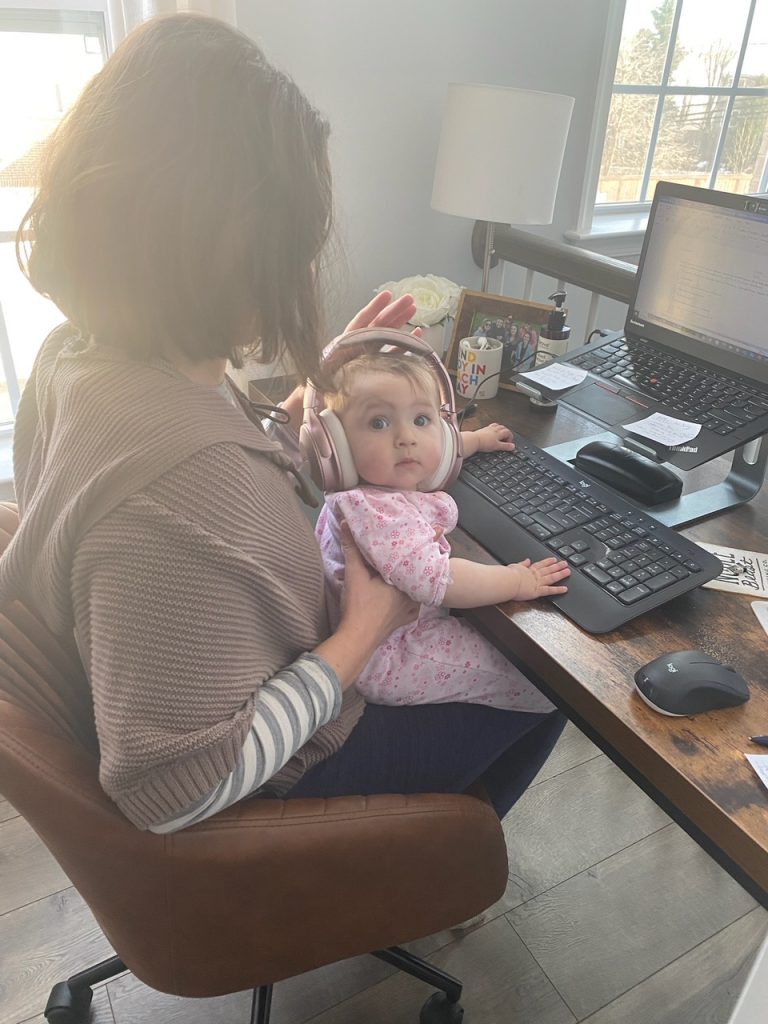
Nothing like a good kid cameo in your meeting.

Looking to hire a babysitter or nanny? Bell Family Company provides fully vetted & FULLY VACCINATED on-demand babysitting, including full and part time nannies, baby nurses, temporary care, help with virtual learning, and more! Learn why BFC is the best childcare agency, with childcare providers available across the U.S. (on-demand service available in the tri-state area). Contact us today to hire!

A Pandemic Pregnancy: What Comes After the Third Trimester

Baby boom or baby bust? To my surprise, I joined the former category during the 2020 COVID-19 pandemic when my husband and I discovered we were expecting our first child on a rainy fall Thursday. If 2020 wasn’t already a blur with the sudden onslaught of a global pandemic that shuttered “life as we know it”, we also squeezed in a small wedding – and now a baby? My planner mode activated into full gear over the following months as we prepared for another big life transition. Now, I reflect back on those months, having gained perspective and a new sense of clarity.

1st Trimester – Be open to spontaneity. Many of us learned to be professionally agile as we quickly pivoted to a virtual world during the pandemic, but we also needed to adapt personally. This includes resisting our desire to control outcomes or stick to a set plan. Like many of us didn’t see the pandemic coming, I didn’t plan this pregnancy, but here we were. After the initial shock wore off over the next 48 hours, I embraced the situation, focused on getting our ducks in a row and watching every baby movie I could stream (Look Who’s Talking trilogy, yes, please!). I soon came to see this spontaneous event as a blessing – excited for the opportunity to become a mom and to gain a new perspective on life.

2nd Trimester – You can’t (and shouldn’t) get everything you want. Going through my first pregnancy during a pandemic brought its challenges – no traveling to be with my family for Thanksgiving or Christmas, no one to share my growing baby bump with except my husband and the four walls of our home and going to all my baby check-up appointments solo were tough. These trying moments surely brought frustration and some tears, but I learned to deal. Instead, we celebrated a quiet holiday at home, I texted lots of baby bump selfies to keep my family updated and virtual technology allowed for both a Zoom baby shower and for my husband to see and hear the baby’s ultrasound via FaceTime. After all, we were lucky to be healthy and together amidst the larger hardships so many others faced.

3rd Trimester – Be present. Two weeks before my due date I opened my journal to reflect on all that we’ve been through over the last year and the final days before our daughter’s arrival. I set an intention to be present, positive, at peace and patient as a parent. This moment of presence prompted me to write my future child a letter. She’ll one day open this letter and learn about our journey, the extraordinary time she was born and how excited we were to meet her.

4th Trimester – Practice daily gratitude. Yes, there is a fourth trimester of pregnancy and it’s called postpartum. There are many adjustments and worries when bringing a new baby home. But my days would become instantly better when I paused to take stock of what I was grateful for – a healthy new baby, a safe delivery, a new home for our family and a job that offers adequate paid parental leave to care for and bond with our newborn. These moments of gratitude brought peace and reinforced what mattered most. I continue to remind myself each day to be grateful for life’s many blessings.

Becoming a mom was my pandemic silver lining. While both were unexpected, my pandemic pregnancy gave me a new perspective and appreciation in life. I was able to slow down, prioritize what mattered most and eventually, recharge. We have all experienced loss, uncertainty and fear during this trying time. But I hope we also have gained a new perspective and appreciation for life – and found our silver lining.

This article was written by Jamie Bell, working mom, wife & Bell sister

Looking to hire a babysitter or nanny? Bell Family Company provides fully vetted on-demand babysitting, including full and part time nannies, baby nurses, temporary care, help with virtual learning, and more! Learn why BFC is the best childcare agency, with childcare providers available across the U.S. (on-demand service available in the tri-state area). Contact us today to hire!