Category Archives: Play/Games

5 Simple Ways Parents & Caregivers Can Build Emotional Skills Through Play

Big feelings are a part of childhood. Whether it’s frustration over losing a game, disappointment when plans change, or excitement that’s hard to contain, children are learning how to understand and navigate their emotions every day.

One of the biggest misconceptions about emotional development is that kids should simply “know” how to manage their feelings. But they don’t. Children are born with all of the feelings, but none of the skills to manage them. Those skills, like identifying emotions, calming their bodies, solving problems, and taking another person’s perspective, are learned over time through caring relationships and repeated practice.

The good news? Emotional skills don’t have to be taught through long lectures or formal lessons. Some of the most meaningful learning happens through play.

Whether you’re a parent, nanny, or babysitter, here are five simple ways to help children build emotional skills during everyday play.

1. Name emotions as they happen.

Before children can manage their emotions, they first need to recognize them. When a child is frustrated, excited, nervous, or proud, simply naming the emotion helps build emotional awareness.

You might say:

“It looks like you’re feeling disappointed that your tower fell.”

Or:

“You’re really excited for Grandma to come over!”

Over time, children build the vocabulary they need to recognize, understand, and express what they’re feeling.

2. Read stories that help kids explore big emotions.

Stories allow children to experience big feelings through relatable characters before they encounter those same situations in real life. Whether you’re reading at bedtime, during a quiet afternoon, or while babysitting for the evening, books create natural opportunities to pause, ask questions, and wonder together:

“How do you think they felt?”

“Why do you think they made that choice?”

“What would you have done?”

The Emmers Big-Hearted Resilience storybook collection was created with child development experts to help children navigate common challenges like frustration, disappointment, and perseverance through engaging stories that spark meaningful conversations.

3. Practice emotional skills through play.

We wouldn’t expect a child to learn to ride a bike without practicing. Emotional skills work the same way.

Children don’t become empathetic, resilient, or emotionally regulated simply because we tell them to. They build those skills by practicing them over and over again in safe, connected moments.

Screen-free games, pretend play, and cooperative activities give children opportunities to identify emotions, take another person’s perspective, tolerate frustration, solve problems, and celebrate others’ successes.

The Emmers Emotion Seekers board game was designed with child-development experts to make that practice fun, giving children repeated opportunities to build these skills while laughing, connecting, and asking to play another round.

4. Get curious instead of rushing to solve.

When children experience big feelings, our instinct is often to fix the problem. But emotional growth doesn’t happen because children avoid hard feelings. It happens because they learn they can move through them.

Instead of immediately offering solutions, try getting curious. You might ask:

“Hmm… what do you think you could try next?”

“What do you think would help?”

Curiosity communicates confidence. It tells children:

“I believe you can handle hard things, and I’ll help you figure it out.”

Those moments build confidence, flexible thinking, and problem-solving skills that last far beyond childhood.

5. Remember that emotional skills take time.

We don’t expect children to become fluent readers after one bedtime story or master riding a bike after one afternoon. Emotional skills develop the same way: through hundreds of small, everyday moments.

Every conversation, every game, every story, and every opportunity to work through disappointment becomes another chance to strengthen those emotional muscles.

That’s why the Ultimate Emmers Bundle pairs three Big-Hearted Resilience storybooks with the Emotion Seekers board game. The books introduce emotional concepts through relatable stories, while the game gives children repeated opportunities to practice those same skills through play.

Whether you’re a parent, nanny, babysitter, or educator, those everyday moments of connection can make a lasting difference.

At Emmers, we believe emotional skills are some of the most important skills children will ever build, and play is one of the most joyful ways to build them.
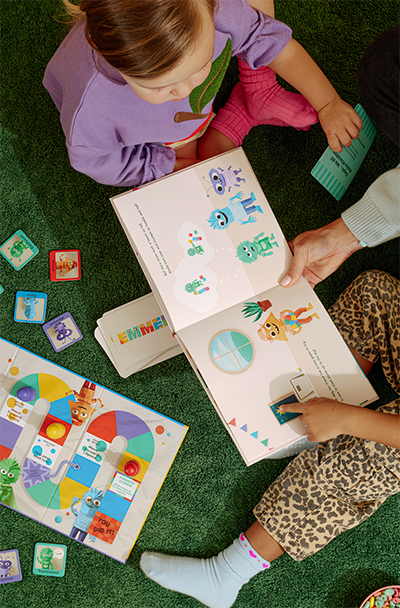
Emmers Emotion Seekers Game

Emmers is created by child development experts and founded by mom and psychology advocate Melanie Sperling Palmer. Designed to make emotional learning fun for both kids and parents, Emmers gives families practical, research-backed tools to strengthen emotional wellbeing one meaningful moment at a time. This blog is in collaboration with Melanie Palmer, Founder & CEO of Emmers.

The Only Toy Gift Guide Needed From NY Mag feat. Lindsay Bell

It’s that time of the year where our minds run wild trying to think of the perfect gift to give the children. Our Founder & Owner, Lindsay Bell, teamed up with The Strategist at NY Mag, and helped to create the ultimate toy gift guide for children ages 7, 9 and 10. Read for Lindsay’s top picks and check out the full lists per age group below. Happy shopping, readers!

For your 7-year-old: Ultimate Secret Formula Lab

“This chemistry lab is mesmerizing for those kids who like to mix potions,” says Lindsay Bell, founder of the Bell Family child-care company. It comes with beakers, test tubes, petri dishes, the works, and inside them you can combine mixtures of, say, phenol red and ammonia to create invisible vapors.

For your 9-year-old: ThinkFun Code Master Programming Logic Game

It’s an enticing concept — your avatar traveling to an exotic land to collect “power crystals.” First you have to write a program for yourself using the included Guide Scroll to set out your pathways along the map (this mimics the step-by-step sequences that need to be followed in computer programming). Once you snatch up all of the crystals on your designed route, collecting “action” tokens along the way, you win. What might not be noticed in all the intensity, though, is just how many fundamentals of programming you’re learning (even “conditional loops” and “branches”), which is why this game is a favorite of Lindsay Bell, founder and owner of Bell Family child-care company. Plus there are progressive levels of difficulty: An Amazon reviewer whose husband is an engineer wrote that even he enjoys the harder ones.

For your 10-year-old: Snap Circuits Arcade Electronics Exploration Kit

Snap Circuits, says Rumaan Alam, a novelist and father of a 7-year-old and a 10-year-old, “is one of a whole slew of toys meant to appeal to STEM true believers. I don’t know if it’ll ensure your kid grows up to be an engineer, but I do know my kids spent many a cooped-up winter day building an AM radio or figuring out how to turn a little motor.” Ruka Curate, founder of the Tiny Treasures Nanny Agency, recommends this arcade-themed kit, which is a more advanced Snap Circuits version for 10-year-olds. Another option, according to Lindsay Bell, founder and owner of Bell Family child-care company, is Snap Circuits Extreme, although it’s a bit more expensive.

For the full gift guides from The Strategist at NY Mag, visit the links below.

Toy Gift Guide for 7-Year-Olds
Toy Gift Guide for 9-Year-Olds
Toy Gift Guide for 10-Year-Olds

Written by Taylor Bell, Marketing & Social Media

Simple Summer Fun!

Now that burnout is an official medical diagnosis, I think it’s a good time to bring some simplicity back into our lives this summer.

There is always the temptation of the zillion great summer camp options available. I’ll admit I signed up for a week long one, one for each of my kids with the school they will be attending in the fall. The intention was to practice getting used to that school so drop off in the fall would be a breeze for both kid and me… mostly me.

This simple summer phenomena is not genius. It was how I was raised and probably how most of you and your parents were raised. With how complicated life seems to be today, here is what we will be doing to bring simplicity back. Beware, your kids may be bored at times, but I think that’s good! That’s when creativity is born!

  1. Set up a safety town outside in the driveway. Grandma sent kid size street signs that are easy to set up and take down.
  2. Host a lemonade stand and have your child make flyers to drop off at the neighbor’s house (this is the entrepreneur in me).
  3. Swim, swim, swim! At home or a local pool (invite friends over, play pool games, etc.).
  4. Play in the back yard. Sit toys or objects out and let the kids use their imagination to build and play.
  5. Set up different areas in the house with different activities (e.g., front yard is sidewalk chalk, media room is trains, office is reading).
  6. Go on a walk.
  7. Go to a splash pad.
  8. Pick vegetables at your garden or a local garden.
  9. Water plants and teach your child about taking care of the environment.
  10. Help clean up and make it a game.
  11. Help mom cook! Teach your child about measuring cups, measuring spoons and practice the names of the ingredients.
  12. Visit Grandma and Grandpa for bonding time.
  13. Take a nap or have downtime/rest.

Written by our Founder & Owner, Lindsay Bell

The Winter Olympic Games for Kids

Sitting and watching the Olympic games is great, but wouldn’t it be even greater to be involved in the winter game action yourself?

After tuning into the various games on television, and teaching your children about the sport(s), turn your living room into a mini PyeongChang, and create some winter Olympic games of your own!

Of course, these games aren’t nearly as rigorous as freestyle skiing or speed skating, but they are guaranteed to be just as fun! Maybe more along the lines of curling, if you will.

1. Snowball toss: For this game, grab some plastic cups, markers, and cotton balls, and then try your luck at getting the cotton balls into the cups.

2. Snowman slam: You’ll need white foam cups, construction paper or markers, and some white socks for this one.  Then see if you can toss the balled up socks and knock down all the snowmen. This could be fun for bowling, too!

3. Pin the carrot: Think of this as the winterized version of pin the tail on the donkey. A large roll of white paper will work best, along with some colored construction paper, and a blind fold.

4. FREEZE: Number four on the linked list brings a musical game where all you’ll need is something to play music and an open space for the kiddies to dance. When the the music stops, the kids have to freeze!

5. Snowman draw game: Grab some paper plates and markers, and you’ll be all set. The child will hold the paper plate on their head with one hand and try to draw a snowman holding a marker with the other.

If you try out the games, we want to see it! Post your photos to Facebook and tag @BellFamilyCompany in your post!

Written by our Marketing & Social Media Consultant, Taylor Bell