Tag Archives: playtime

5 Simple Ways Parents & Caregivers Can Build Emotional Skills Through Play

Big feelings are a part of childhood. Whether it’s frustration over losing a game, disappointment when plans change, or excitement that’s hard to contain, children are learning how to understand and navigate their emotions every day.

One of the biggest misconceptions about emotional development is that kids should simply “know” how to manage their feelings. But they don’t. Children are born with all of the feelings, but none of the skills to manage them. Those skills, like identifying emotions, calming their bodies, solving problems, and taking another person’s perspective, are learned over time through caring relationships and repeated practice.

The good news? Emotional skills don’t have to be taught through long lectures or formal lessons. Some of the most meaningful learning happens through play.

Whether you’re a parent, nanny, or babysitter, here are five simple ways to help children build emotional skills during everyday play.

1. Name emotions as they happen.

Before children can manage their emotions, they first need to recognize them. When a child is frustrated, excited, nervous, or proud, simply naming the emotion helps build emotional awareness.

You might say:

“It looks like you’re feeling disappointed that your tower fell.”

Or:

“You’re really excited for Grandma to come over!”

Over time, children build the vocabulary they need to recognize, understand, and express what they’re feeling.

2. Read stories that help kids explore big emotions.

Stories allow children to experience big feelings through relatable characters before they encounter those same situations in real life. Whether you’re reading at bedtime, during a quiet afternoon, or while babysitting for the evening, books create natural opportunities to pause, ask questions, and wonder together:

“How do you think they felt?”

“Why do you think they made that choice?”

“What would you have done?”

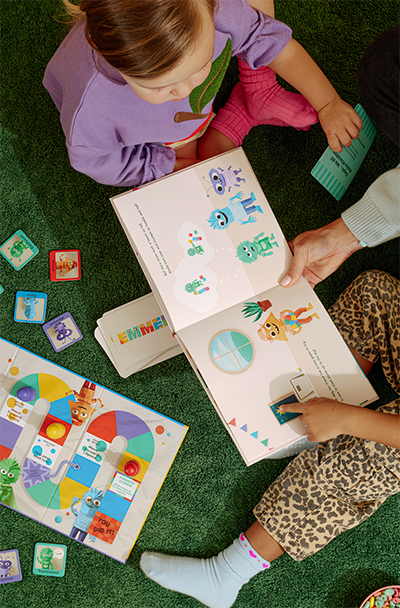
The Emmers Big-Hearted Resilience storybook collection was created with child development experts to help children navigate common challenges like frustration, disappointment, and perseverance through engaging stories that spark meaningful conversations.

3. Practice emotional skills through play.

We wouldn’t expect a child to learn to ride a bike without practicing. Emotional skills work the same way.

Children don’t become empathetic, resilient, or emotionally regulated simply because we tell them to. They build those skills by practicing them over and over again in safe, connected moments.

Screen-free games, pretend play, and cooperative activities give children opportunities to identify emotions, take another person’s perspective, tolerate frustration, solve problems, and celebrate others’ successes.

The Emmers Emotion Seekers board game was designed with child-development experts to make that practice fun, giving children repeated opportunities to build these skills while laughing, connecting, and asking to play another round.

4. Get curious instead of rushing to solve.

When children experience big feelings, our instinct is often to fix the problem. But emotional growth doesn’t happen because children avoid hard feelings. It happens because they learn they can move through them.

Instead of immediately offering solutions, try getting curious. You might ask:

“Hmm… what do you think you could try next?”

“What do you think would help?”

Curiosity communicates confidence. It tells children:

“I believe you can handle hard things, and I’ll help you figure it out.”

Those moments build confidence, flexible thinking, and problem-solving skills that last far beyond childhood.

5. Remember that emotional skills take time.

We don’t expect children to become fluent readers after one bedtime story or master riding a bike after one afternoon. Emotional skills develop the same way: through hundreds of small, everyday moments.

Every conversation, every game, every story, and every opportunity to work through disappointment becomes another chance to strengthen those emotional muscles.

That’s why the Ultimate Emmers Bundle pairs three Big-Hearted Resilience storybooks with the Emotion Seekers board game. The books introduce emotional concepts through relatable stories, while the game gives children repeated opportunities to practice those same skills through play.

Whether you’re a parent, nanny, babysitter, or educator, those everyday moments of connection can make a lasting difference.

At Emmers, we believe emotional skills are some of the most important skills children will ever build, and play is one of the most joyful ways to build them.
Emmers Emotion Seekers Game

Emmers is created by child development experts and founded by mom and psychology advocate Melanie Sperling Palmer. Designed to make emotional learning fun for both kids and parents, Emmers gives families practical, research-backed tools to strengthen emotional wellbeing one meaningful moment at a time. This blog is in collaboration with Melanie Palmer, Founder & CEO of Emmers.

Farm Camp (for Kids) Does Exist!

My city boy husband knows I enjoy a good article proving the outdoors and farm life are good for the soul. He recently forwarded me “What City Kids Can Learn On My Farm,” by Larissa Phillips. She is a former Brooklynite turned upstate farmer. She shares the joys of seeing her own children working and playing on their family’s farm. She even shares the experience with city kids and their parents offering a place to stay and the opportunity to do jobs on the farm.

Earlier this year my parents volunteered to take our two oldest boys for 16 days while I recovered from my last birth. My parents own a small farm in northeast Ohio, and every summer we road trip there to stay on the farm. However, this year we couldn’t all travel with the new baby so the boys travelled with their grandparents back to Ohio.

Each day, my mother sent photos of what the kids were doing. My parents are both former educators — they like routine and follow a more strict parenting style. Loving, but firm is a good way to put it. The boys love it and seem to thrive. 

A typical schedule looks like this:

  • – Wake up: make beds, get dressed & take clothes to the laundry 
  • – Breakfast & brain exercises (my mom loves work books)
  • – Outside play till Papa gets back from the golf course
  • – Jobs: cleaning the barn, feed/water the cows, weed or pick veggies out of the garden, mow the lawn, paint the barn, sweep the garage, etc.
  • – Lunch time
  • – Go for a bike ride or hike in the woods
  • – Jobs (cont.): fix the cars, air conditioner or something else that broke
  • – Cousin time at the playground in the back yard 
  • – Downtime reading in the hammock 
  • – Dinner
  • – Bath & TV: they are allowed to watch something they typically watch at home or they watch Gunsmoke with Papa
  • – Bedtime in the basement (boys only!)

Can you imagine how tired kids would be after this schedule? Absolutely pooped! In bed by 8:30 p.m. and willingly. 

They missed home, but lived it up in Ohio. When they came home to hot Dallas, the good habits continued. My oldest willingly went to our small garden, weeded it and picked all the carrots. I usually have to ask for this. The second oldest usually has to be asked 5x to go outside to ride his bike for some exercise, but since getting back home he does it on his own. 

It is the best experience for everyone. I got some quality time with the baby and the boys got lots of independence and learned excellent life skills and habits on the farm. 

Larissa you are definitely onto something!

My second oldest on the farm

Looking to hire a babysitter or nanny? Bell Family Company provides fully vetted & FULLY VACCINATED on demand babysitting, including full and part time nannies, baby nurses, temporary care and more! Learn why BFC is the best childcare agency, with childcare providers available across the U.S. (on-demand service available in the Tri-state & Dallas areas). Contact us today to hire!

Training Thursday Vol. 10 – Playtime

Welcome to volume 10 of Bell Family’s video training series, where each Thursday we release a video to help coach sitters on an array of childcare topics.
This week we are featuring a training video on playtime!
Here are a handful of ways to easily and actively engage lil’ ones:
1. Read. Be animated! Act out the characters, make sounds, and point at the words or object you are referring to.
2. Sing. Sing child nursery rhymes or songs. You can act many of them out like ‘Itsy Bitsy Spider’ and ‘Wheels on the Bus’.
3. ‘Ring-Around-the-Rosy’ and ‘Duck Duck Goose’. These are two easy, play anywhere games, that toddlers and up can enjoy.
4. Grab a ball. You can do so many things with a ball and a child that is six months and up (roll to one another, play soccer, catch, keep it up, etc.).
5. Color. Grab some paper and poster board, and draw/color simple pictures (flowers, planes, farm animals, etc.). Then the child can show their parent when they get home.
6. Art/crafts. You can use a lot of the things already in the home. Noodles and yarn to make necklaces, make cookies, play restaurant (you be the guest and the child the server), play theater (where the child puts on a production for you), and use props in the home for the show.
Here are some fast playtime clean up tips:
1. Tidy up: Always tidy up the children’s play or eating areas before the parents come home. If the child is of age (toddler and up) have them help you. You can even make a game or song out of it to make it fun!
2. Wipe down: Wipe down the toys with a wet cloth and some dish soap after playtime, especially if you saw the child put something in their mouth.
3. Dishes/cups/bottles: Make sure these items are placed in the dishwasher or washed in the sink before the parents come home. The parents should not come home to a sink full of the children’s dishes. It takes just an extra minute, and makes such a difference to the parents.
These videos are recommended to all BFC childcare providers to view for the latest techniques when caring for children. These videos were designed by our team comprised of long-time babysitters, full-time nannies, mothers, grandmothers, elementary educators, and social worker.
Swings copy
Note: Always follow the family’s instruction and care methods, and keep the family informed of everything with their baby.  These videos are not required to view, but a simple recommendation. For more information or for questions, please contact our office or read our terms.